UDS Vice-Chancellor Participates in World University Presidents Forum and Two Other Major Conferences in China
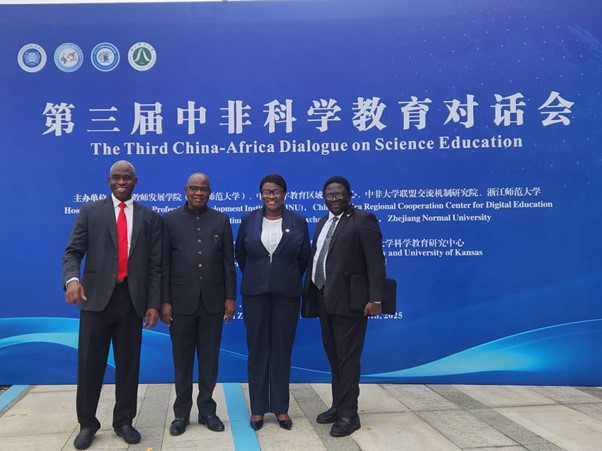
A two-member delegation from the University for Development Studies (UDS), led by Vice-Chancellor Professor Seidu Al-hassan and accompanied by the Dean of the Faculty of Social Sciences, Professor Eliasu Alhassan, recently represented the University at three high-level international conferences in China.
The first of these events, the 2025 World University Presidents Forum, was held from 7–10 November 2025 in Hangzhou and was hosted by Zhejiang University in collaboration with the China Association of Higher Education (CAHE). The forum convened university leaders from over 40 countries to deliberate on the theme, “Artificial Intelligence and the Future of Higher Education.” Professor Al-hassan participated as a panel discussant, offering insights on the role of AI in promoting educational access, research productivity, and innovation in developing countries. His contribution addressed key forum themes, including AI and the scientific-research paradigm shift, digital transformation and higher-education equity, and governance innovation in higher education.
The delegation’s second engagement took place at a Science Education Conference in Zhejiang Province. During this conference, Professor Seidu Al-hassan delivered a keynote address on “Achieving Sustainable Rural Development in Africa through STEM Education,” where he highlighted the strategic importance of leveraging science, technology, engineering, and mathematics (STEM) education to catalyze rural development, reduce inequalities, and reinforce research-driven innovation across Africa. He emphasized the need to embed STEM curricula within rural communities to align with local development goals, cultivate partnerships linking universities, industries, and local government agencies, and enhance teaching and research capacity to ensure STEM drives sustainable growth beyond purely academic objectives.
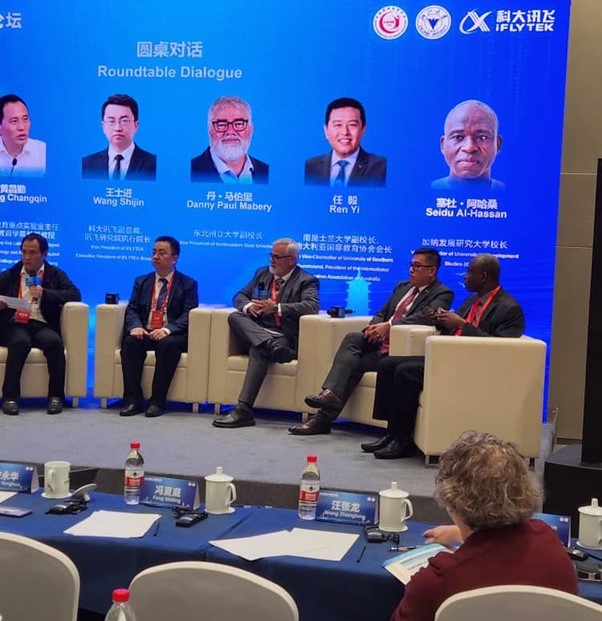
The third conference, held at Zhejiang Normal University, also featured prominent contributions from the UDS delegation. Vice-Chancellor, Professor Al-hassan delivered another keynote address on Science Education, underscoring the importance of global academic partnerships to strengthen research capacity in Africa.
Meanwhile, the Dean of the Faculty of Social Sciences, Professor Eliasu Alhassan presented a paper titled “STEM Education in Ghana: History and Development,” tracing Ghana’s STEM education journey from early curriculum initiatives and policy reforms to contemporary challenges such as infrastructure gaps, teacher training deficits, and limited industry linkages. He called for renewed investment in STEM resources, greater cross-sector collaboration, and stronger international partnerships to accelerate Ghana’s STEM ecosystem.
The participation of the UDS delegation at these prestigious forums carries significant strategic implications. Engaging with global peers enhances UDS’ international visibility and networking, positioning the University among a growing circle of globally connected institutions. The knowledge exchange and insights gained on AI, STEM, and higher-education innovation contribute to enriching UDS’ curricula and institutional knowledge. The conferences also offer avenues to strengthen academic collaborations through joint research, faculty exchange, and student mobility.
Furthermore, the focus on rural development through STEM and technology aligns closely with UDS’development mandate in northern Ghana.
News Desk Report
UDS Media